Grid5000:Home

From Grid5000
Jump to navigation Jump to search
The printable version is no longer supported and may have rendering errors. Please update your browser bookmarks and please use the default browser print function instead.
Slices-ri-white-color.png

Grid'5000 is a precursor infrastructure of SLICES-FR, the French node of SLICES-RI, Scientific Large Scale Infrastructure for Computing/Communication Experimental Studies.
Content on this website is partly outdated. Technical information remains relevant.

Grid'5000

Grid'5000 is a large-scale and flexible testbed for experiment-driven research in all areas of computer science, with a focus on parallel and distributed computing, including Cloud, HPC, Big Data and AI.

Key features:

  • provides access to a large amount of resources: 15000 cores, 800 compute-nodes grouped in homogeneous clusters, and featuring various technologies: PMEM, GPU, SSD, NVMe, 10G and 25G Ethernet, Infiniband, Omni-Path
  • highly reconfigurable and controllable: researchers can experiment with a fully customized software stack thanks to bare-metal deployment features, and can isolate their experiment at the networking layer
  • advanced monitoring and measurement features for traces collection of networking and power consumption, providing a deep understanding of experiments
  • designed to support Open Science and reproducible research, with full traceability of infrastructure and software changes on the testbed
  • a vibrant community of 500+ users supported by a solid technical team


Read more about our teams, our publications, and the usage policy of the testbed. Then get an account, and learn how to use the testbed with our Getting Started tutorial and the rest of our Users portal.


Published documents and presentations:

Older documents:


Grid'5000 is supported by a scientific interest group (GIS) hosted by Inria and including CNRS, RENATER and several Universities as well as other organizations. Inria has been supporting Grid'5000 through ADT ALADDIN-G5K (2007-2013), ADT LAPLACE (2014-2016), and IPL HEMERA (2010-2014).


Current status (at 2026-08-26 21:14): 6 current events, 6 planned (details)


Random pick of publications

Five random publications that benefited from Grid'5000 (at least 3000 overall):

  • Chih-Kai Huang, Guillaume Pierre. Aggregate Monitoring for Geo-Distributed Kubernetes Cluster Federations. IEEE Transactions on Cloud Computing, 2024, 12 (4), pp.1449-1462. 10.1109/TCC.2024.3482574. hal-04736577 view on HAL pdf
  • Sewade Ogun, Abraham T. Owodunni, Tobi Olatunji, Eniola Alese, Babatunde Oladimeji, et al.. 1000 African Voices: Advancing inclusive multi-speaker multi-accent speech synthesis. Interspeech 2024, Sep 2024, Kos Island, Greece. hal-04663033 view on HAL pdf
  • Anas Mokhtari, Baptiste Jonglez, Thomas Ledoux. Towards Digital Sustainability: Involving Cloud Users as Key Players. IC2E 2024 - 12th IEEE International Conference on Cloud Engineering, Sep 2024, Paphos, Cyprus. pp.126-132, 10.1109/IC2E61754.2024.00021. hal-04633237 view on HAL pdf
  • Hugo Reymond. Modèle d'exécution conscient de l'énergie pour les systèmes intermittents. Autre cs.OH. Université de Rennes, 2024. Français. NNT : 2024URENS035. tel-05056937v2 view on HAL pdf
  • Donatien Schmitz, Guillaume Rosinosky, Etienne Rivière. Justin: Hybrid CPU/Memory Elastic Scaling for Distributed Stream Processing ⋆. DAIS 2025 - 25th International Conference on Distributed Applications and Interoperable Systems, Daniel Balouek; Ibéria Medeiros, Jun 2025, Lille, France. pp.1-17. hal-05081993 view on HAL pdf


Latest news

Rss.svgDebian 13 "Trixie" std environment is now the default environment on (almost) all nodes

Dear users,

We are pleased to announce that Debian 13 (Trixie) std environment is

now the default environment on most nodes. See `kaenv3 -l debian%13%` for a list of available variants.

There is some significant evolutions, particularly regarding the

environment modules. Indeed, some components that were included in the environment images are now provided by modules loading, including CUDA, ROCm and OpenMPI.

Node network interface now have both IPv4 and (public) IPv6 addresses

by default, which should have no impact on most uses.

For more informations, see the Release Notes, available at

https://www.grid5000.fr/w/Debian_13_Trixie_environments_release_notes


As previous default environment move, frontend of every sites have been reinstalled in Debian 13 too.


If you have any questions or problems, please contact <support-staff@lists.grid5000.fr>

Best regards,

Nicolas Perrin, for Abaca and Grid’5000/SLICES-FR

Inria, DSI Service Production

-- Grid'5000 Team 14:54, 26 Aug 2026 (CEST)

Rss.svgSome clusters under Debian 13 "Trixie" environment by default and migration maintenance

Dear users,

The default standard environment has changed to Debian 13 for some

selected clusters over the past few weeks.

Here they are:

  • grenoble : vercors4 (3 nodes)
  • lyon  : hydra (4 nodes)
  • sophia  : esterel10 (3 nodes)
  • nancy  : grouille (2 nodes)
  • louvain  : spirou (8 nodes)
  • This is a key step towards the widespread deployment of Debian13. Most

    clusters will be switched to a Debian 13 default environment Wednesday 26 August 2026.

    If you need to, all the variants images (min, nfs, big) are available

    for deployment, see `kaenv3 -l debian%13%` on frontends to list them.

    Remember that there is a significant change concerning the modules. See

    the preview announce : https://www.grid5000.fr/w/News#Upcoming_changes_to_modules

    Best regards,

    For Abaca and Grid'5000/SLICES-FR,

    Nicolas Perrin

    -- Grid'5000 Team 16:00, 02 Jul 2026 (CEST)

    Rss.svgUpcoming changes to modules

    Hello everyone,

    Let's start with a quick TLDR, details on the rationale and implementation are available below: new modules will be available with the new standard environment, and are already live for testing (but not activated by default).

    If you want to test them you need to run the following commands:

    unset MODULEPATH

    module use /grid5000/guix-modules/x86_64/latest
    /grid5000/spack/module-others


    Now for more details: for the past months we have been working on updating the standard environment and the way we provide modules.

    The current way uses Spack under the hood, and is tightly bound to the underlying operating system.

    It's been proven to be quite a burden for the team, and therefore we are changing the way we manage modules to:

    - use a solution oblivious to the Linux flavor; - have means to update software versions automatically, and a clear release cycle; - actually have something reproducible; - be able to automatically test our most sensitive modules when they change (on both OAR and SLURM clusters).

    Under the hood we switched to Guix to manage them²; it will be totally transparent for you.

    The upcoming modules are located in `/grid5000/guix-modules/x86_64`, and you can try them today!

    In order to use them you need to perform the following commands¹:

    unset MODULEPATH

    module use /grid5000/guix-modules/x86_64/latest
    

    The list of modules for the `latest` release is available here:

    https://api.grid5000.fr/explorer/software.

    We know it's missing a few software compared to the current modules, we've tracked them here.

    These should b...

    Rss.svgChanges to VS Code and AI Extensions Usage on Frontend

    Recently, we have observed a critical increase in resource consumption (CPU and memory) on these nodes. This is primarily caused by VS Code Server (or similar) instances and associated AI-assisted coding extensions (such as Copilot, Tabnine, or local LLM agents) running directly on the frontend.

    As a reminder, frontends are strictly dedicated to lightweight tasks: code editing, file management, and job submission. Running heavy background processes or AI agents on these shared machines degrades performance for the entire community and risks crashing the machines. Frontend are not sized for heavy code/system compilation/build either. Heavy tasks must be run on reserved nodes.

    What is changing:

    - ban on frontend: running VS Code Server (or similar), AI extensions, or any background development agents directly on the frontend will shortly be prohibited. - automated cleanup: we will actively monitor these nodes. Any unauthorized, resource-intensive processes or persistent VS Code servers found running on the login nodes will be terminated without prior warning.

    How to continue using VS Code and AI tools?:

    We fully understand that these tools could be essential for your work. Therefore, this usage is completely permitted and supported on the compute nodes.

    To use VS Code and your AI agents properly, you must schedule an interactive session via the batch scheduler (OAR). You can do this by:

    - Requesting an interactive allocation using oarsub -I.

    - Tunneling your VS Code Remote-SSH connection directly to the allocated compute node instead of the frontend

    This ensures you have dedicated resources for your AI tools without impacting other users.

    -- Grid'5000 Team 16:00, 15 Jun 2026 (CEST)


    Read more news

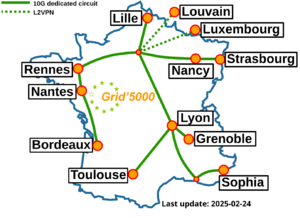
    Grid'5000 sites

    Current funding

    INRIA

    Logo INRIA.gif

    CNRS

    CNRS-filaire-Quadri.png

    Universities

    IMT Atlantique
    Université Grenoble Alpes, Grenoble INP
    Université Rennes 1, Rennes
    Institut National Polytechnique de Toulouse / INSA / FERIA / Université Paul Sabatier, Toulouse
    Université Bordeaux 1, Bordeaux
    Université Lille 1, Lille
    École Normale Supérieure, Lyon

    Regional councils

    Aquitaine
    Auvergne-Rhône-Alpes
    Bretagne
    Champagne-Ardenne
    Provence Alpes Côte d'Azur
    Hauts de France
    Lorraine