Grid5000:Home: Difference between revisions
mNo edit summary |
No edit summary |
||
| Line 27: | Line 27: | ||
<br> | <br> | ||
Published documents and presentations: | Published documents and presentations: | ||
* [https://www.inria.fr/fr/grid5000-20-ans-hpc-reseau-informatique 20th anniversary commemoration (2023)] | * [https://www.inria.fr/fr/grid5000-20-ans-hpc-reseau-informatique 20th anniversary commemoration (2023)] → [https://www.youtube.com/watch?v=UD5-Y0vcmVI presentations video replay] (French only) | ||
* [[Media:Grid5000.pdf|Presentation of Grid'5000]] (April 2019) | * [[Media:Grid5000.pdf|Presentation of Grid'5000]] (April 2019) | ||
* [https://www.grid5000.fr/mediawiki/images/Grid5000_science-advisory-board_report_2018.pdf Report from the Grid'5000 Science Advisory Board (2018)] | * [https://www.grid5000.fr/mediawiki/images/Grid5000_science-advisory-board_report_2018.pdf Report from the Grid'5000 Science Advisory Board (2018)] | ||
Revision as of 11:40, 27 August 2026
 Grid'5000 is a precursor infrastructure of SLICES-FR, the French node of SLICES-RI, Scientific Large Scale Infrastructure for Computing/Communication Experimental Studies.
|
|
Grid'5000 is a large-scale and flexible testbed for experiment-driven research in all areas of computer science, with a focus on parallel and distributed computing, including Cloud, HPC, Big Data and AI. Key features:
Older documents:
|
Dear users, We are pleased to announce that Debian 13 (Trixie) std environment is now the default environment on most nodes. See `kaenv3...
Dear users, The default standard environment has changed to Debian 13 for some selected clusters over the past few weeks. Here the... Hello everyone, Let's start with a quick TLDR, details on the rationale and implementation are available below: new modules will be avail...
Recently, we have observed a critical increase in resource consumption (CPU and memory) on these nodes. This is primarily caused by VS Code Serv... |

Random pick of publications
Five random publications that benefited from Grid'5000 (at least 3009 overall):
- Albert d'Aviau de Piolant, Hayfa Tayeb, Bérenger Bramas, Mathieu Faverge, Abdou Guermouche, et al.. Improving energy efficiency of HPC applications using unbalanced GPU power capping. HCW (Ipdps workshop), Jun 2025, Milan (Italie), Italy. hal-04883872v2 view on HAL pdf
- Gautier Evennou, Vivien Chappelier, Ewa Kijak, Teddy Furon. SWIFT: Semantic Watermarking for Image Forgery Thwarting. WIFS 2024 - 16th IEEE International Workshop on Information Forensics and Security, IEEE, Dec 2024, Roma, Italy. pp.1-6. hal-04728070 view on HAL pdf
- Jérémie Rodez, Patricia Stolf, Thierry Monteil. Online Placement of Distributed Machine Learning Services over Heterogeneous IoT Platforms. 2026. hal-05726991 view on HAL pdf
- Hugo Reymond. Modèle d'exécution conscient de l'énergie pour les systèmes intermittents. Autre cs.OH. Université de Rennes, 2024. Français. NNT : 2024URENS035. tel-05056937v2 view on HAL pdf
- Neuville-Burguière Benjamin, Huet Fabrice, Baude Françoise. Latency Aware and ressource-efficient bin pack autoscaling for distributed event queues : An application to microservices architectures. Conférence francophone d'informatique en Parallélisme, Architecture et Système (COMPAS 2026), Jun 2026, Anglet, France. hal-05659911 view on HAL pdf
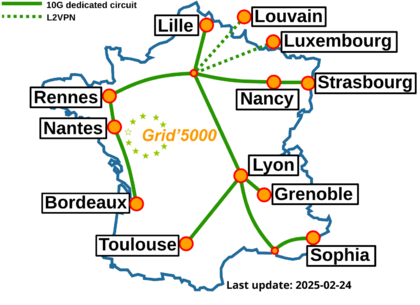
Grid'5000 sites
Current funding
INRIA
|
CNRS
|
UniversitiesIMT Atlantique |
Regional councilsAquitaine |