Grid5000:Home: Difference between revisions
mNo edit summary |
mNo edit summary |
||
| Line 20: | Line 20: | ||
* '''advanced monitoring and measurement features for traces collection of networking and power consumption''', providing a deep understanding of experiments | * '''advanced monitoring and measurement features for traces collection of networking and power consumption''', providing a deep understanding of experiments | ||
* '''designed to support Open Science and reproducible research''', with full traceability of infrastructure and software changes on the testbed | * '''designed to support Open Science and reproducible research''', with full traceability of infrastructure and software changes on the testbed | ||
* '''a vibrant community''' of | * '''a vibrant community''' of 1000+ users supported by a solid technical team | ||
<br> | <br> | ||
Latest revision as of 21:38, 10 November 2026
 Grid'5000 is a precursor infrastructure of SLICES-FR, the French node of SLICES-RI, Scientific Large Scale Infrastructure for Computing/Communication Experimental Studies.
|
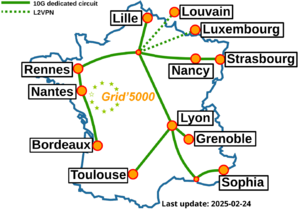 Grid'5000 is a large-scale and flexible testbed for experiment-driven research in all areas of computer science, with a focus on parallel and distributed computing, including Cloud, HPC, Big Data and AI. Key features:
Older documents:
|
Most recent news
Dear users, Due to multiple occurences of bad usages of the access machine, the technical team has decided to change the SSH connection mode to the...
Dear users, We are pleased to announce that Debian 13 (Trixie) std environment is now the default environment on most nodes. See `kaenv3 -l debian%...
Dear users, The default standard environment has changed to Debian 13 for some selected clusters over the past few weeks. Here they are: Hello everyone, Let's start with a quick TLDR, details on the rationale and implementation are available below: new modules will be available with ... |

Random pick of publications
Five random publications that benefited from Grid'5000 (at least 3048 overall):
- Gaspard Michel, Elena Epure, Romain Hennequin, Christophe Cerisara. Evaluating LLMs for Quotation Attribution in Literary Texts: A Case Study of LLaMa3. 2025 Conference of the Nations of the Americas Chapter of the Association for Computational Linguistics: Human Language Technologies, Apr 2025, Albuquerque, New Mexico, United States. pp.742-755, 10.18653/v1/2025.naacl-short.62. hal-05245297 view on HAL pdf
- Youenn Merel Jourdan, Mathieu Acher, Camille Maumet. In the Search for Truth: Navigating Variability in Neuroimaging Software Pipelines. SPLC 2025 - 29th ACM International Systems and Software Product Line Conference, Association for Computing Machinery (ACM), Sep 2025, Coruna, Spain, Spain. pp.129-135, 10.1145/3744915.3748470. hal-05158426 view on HAL pdf
- Célia Mahamdi. Multi-Consensus distribué : agrégation et révocabilité. Réseaux et télécommunications cs.NI. Sorbonne Université, 2024. Français. NNT : 2024SORUS426. tel-04919363 view on HAL pdf
- Govind KP, Guillaume Pierre, Romain Rouvoy. Energy-Efficient Right-Sizing of Kafka-like Message Brokers for IoT Workloads. ICPE 2026 - 17th ACM/SPEC International Conference on Performance Engineering, ACM; SPEC, May 2026, Florence, Italy. 10.1145/3777884.3797015. hal-05512966 view on HAL pdf
- Mazigh Saoudi, Souheib Baarir, Julien Sopena, Thibault Lejemble. D-Painless: A Framework for Distributed Portfolio SAT Solving. Tools and Algorithms for the Construction and Analysis of Systems, May 2025, Hamilton, Canada. pp.45-64, 10.1007/978-3-031-90653-4_3. hal-05084417 view on HAL pdf
Grid'5000 sites
Current funding
INRIA
|
CNRS
|
UniversitiesIMT Atlantique |
Regional councilsAquitaine |