Grid5000:Home: Difference between revisions
mNo edit summary |
No edit summary |
||
| Line 27: | Line 27: | ||
<br> | <br> | ||
Published documents and presentations: | Published documents and presentations: | ||
* [https://www.inria.fr/fr/grid5000-20-ans-hpc-reseau-informatique 20th anniversary commemoration (2023)] | * [https://www.inria.fr/fr/grid5000-20-ans-hpc-reseau-informatique 20th anniversary commemoration (2023)] → [https://www.youtube.com/watch?v=UD5-Y0vcmVI presentations video replay] (French only) | ||
* [[Media:Grid5000.pdf|Presentation of Grid'5000]] (April 2019) | * [[Media:Grid5000.pdf|Presentation of Grid'5000]] (April 2019) | ||
* [https://www.grid5000.fr/mediawiki/images/Grid5000_science-advisory-board_report_2018.pdf Report from the Grid'5000 Science Advisory Board (2018)] | * [https://www.grid5000.fr/mediawiki/images/Grid5000_science-advisory-board_report_2018.pdf Report from the Grid'5000 Science Advisory Board (2018)] | ||
Revision as of 11:40, 27 August 2026
 Grid'5000 is a precursor infrastructure of SLICES-FR, the French node of SLICES-RI, Scientific Large Scale Infrastructure for Computing/Communication Experimental Studies.
|
|
Grid'5000 is a large-scale and flexible testbed for experiment-driven research in all areas of computer science, with a focus on parallel and distributed computing, including Cloud, HPC, Big Data and AI. Key features:
Older documents:
|
Dear users, We are pleased to announce that Debian 13 (Trixie) std environment is now the default environment on most nodes. See `kaenv3...
Dear users, The default standard environment has changed to Debian 13 for some selected clusters over the past few weeks. Here the... Hello everyone, Let's start with a quick TLDR, details on the rationale and implementation are available below: new modules will be avail...
Recently, we have observed a critical increase in resource consumption (CPU and memory) on these nodes. This is primarily caused by VS Code Serv... |

Random pick of publications
Five random publications that benefited from Grid'5000 (at least 3009 overall):
- Guillaume Schreiner, Pierre Neyron. SLICES-FR : l’infrastructure de recherche nationale pour l’expérimentation Cloud et Réseaux du futur. JRES 2024 - Journées réseaux de l'enseignement et de la recherche, Renater, Dec 2024, Rennes, France. pp.1-15. hal-04893845 view on HAL pdf
- Antoine Franchini, Stéphane Girard, Anne Dutfoy. Adaptive confidence intervals for extreme quantiles from heavy-tailed distributions. Statistics and Computing, 2026, 36, pp.175. 10.1007/s11222-026-10930-9. hal-05322341v3 view on HAL pdf
- Eva Giboulot, Teddy Furon. WaterMax: breaking the LLM watermark detectability-robustness-quality trade-off. NeurIPS 2024 - 38th Conference on Neural Information Processing Systems, Dec 2024, Vancouver, Canada. pp.1-34. hal-04766606 view on HAL pdf
- Jérémie Rodez, Patricia Stolf, Thierry Monteil. Online Placement of Distributed Machine Learning Services over Heterogeneous IoT Platforms. 2026. hal-05726991 view on HAL pdf
- Roblex Nana Tchakoute, Claude Tadonki, Petr Dokladal, Petr Dokladal, Youssef Mesri. A Flexible Operational Framework for Energy Profiling of Programs. 2024 International Symposium on Computer Architecture and High Performance Computing Workshops (SBAC-PADW), Nov 2024, Hilo, United States. pp.12-22, 10.1109/SBAC-PADW64858.2024.00014. hal-04819054 view on HAL pdf
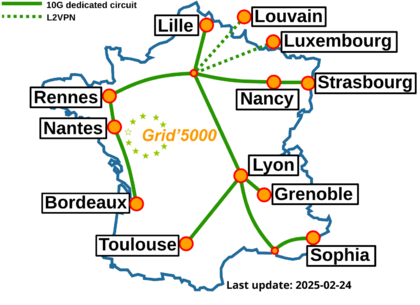
Grid'5000 sites
Current funding
INRIA
|
CNRS
|
UniversitiesIMT Atlantique |
Regional councilsAquitaine |