Grid5000:Home: Difference between revisions

From Grid5000
Jump to navigation Jump to search
No edit summary
No edit summary
 
(79 intermediate revisions by 11 users not shown)
Line 2: Line 2:
{|width="95%"
{|width="95%"
|- valign="top"
|- valign="top"
|bgcolor="#f5fff5" style="border:1px solid #cccccc;padding:1em;padding-top:0.5em;"|
|bgcolor="#888888" style="border:1px solid #cccccc;padding:2em;padding-top:1em;"|
[[Image:Logo.png|left]]
[[File:Slices-ri-white-color.png|260px|left|link=https://www.slices-ri.eu]]
<br>
<b>Grid'5000 is a precursor infrastructure of [https://www.slices-ri.eu SLICES-RI], Scientific Large Scale Infrastructure for Computing/Communication Experimental Studies.</b>
''a scientific instrument designed to support experiment-driven research in all areas of computer science related to parallel, large-scale or distributed computing and networking'' <br>
<br/>
[[media:seminaire_intro.pdf|Download the latest general introduction]], or a [https://www.grid5000.fr/screencast/index.html screencast of recent webUI developments]
Content on this website is partly outdated. Technical information remains relevant.
|}
|}
{{#status:0|0|0|http://bugzilla.grid5000.fr/status/upcoming.json}}
== Latest updates from Grid'5000 users ==
* '''Publications'''
{{#publications:3||**}}
==Latest news==
=== Grid'5000 users win second prize at CCGRID 2013's SCALE challenge ===
Snooze based entry running on Grid'5000 entry wins [http://www.pds.ewi.tudelft.nl/ccgrid2013/awards/ 2nd prize] at [http://www.pds.ewi.tudelft.nl/ccgrid2013/ CCGrid 2013] [http://www.pds.ewi.tudelft.nl/ccgrid2013/calls/scale-challenge/ SCALE challenge]: well done Matthieu and Anne-Cécile for defending the entry titled ''Scalability of the Snooze Autonomic Cloud Management System'' by Eugen Feller, Christine Morin, Matthieu Simonin, Anne-Cécile Orgerie, and Yvon Jégou.


=== Grid'5000 users finalists of the SCALE'2013 challenge ===
{|width="95%"
Two submissions (out of five) from Grid'5000 users took part in the final of the international SCALE'2013 challenge (held with CCGrid'2013):
|- valign="top"
* D. Balouek, A. Lèbre, F. Quesnel Flauncher and DVMS -- Deploying and Scheduling Thousands of Virtual Machines on Hundreds of Nodes Distributed Geographically
|bgcolor="#f5fff5" style="border:1px solid #cccccc;padding:1em;padding-top:0.5em;"|
* Eugen Feller, Christine Morin, Matthieu Simonin, Anne-Cécile Orgerie, and Yvon Jégou -- Scalability of the Snooze Autonomic Cloud Management System.
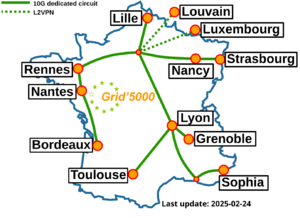
[[Image:g5k-backbone.png|thumbnail|260px|right|Grid'5000|link=https://www.grid5000.fr]]
'''Grid'5000 is a large-scale and flexible testbed for experiment-driven research in all areas of computer science, with a focus on parallel and distributed computing, including Cloud, HPC, Big Data and AI.'''


The first proposition presents the deployment and scheduling of thousands of virtual machines, conducted with the Flauncher and DVMS frameworks, across the Grid'5000 testbed.
Key features:
The frameworks have been able to deploy and schedule up to 10000 VMs during the tests. This research has been conducted in the context of the INRIA Hemera initiative.
* provides '''access to a large amount of resources''': 15000 cores, 800 compute-nodes grouped in homogeneous clusters, and featuring various technologies: PMEM, GPU, SSD, NVMe, 10G and 25G Ethernet, Infiniband, Omni-Path
* '''highly reconfigurable and controllable''': researchers can experiment with a fully customized software stack thanks to bare-metal deployment features, and can isolate their experiment at the networking layer
* '''advanced monitoring and measurement features for traces collection of networking and power consumption''', providing a deep understanding of experiments
* '''designed to support Open Science and reproducible research''', with full traceability of infrastructure and software changes on the testbed
* '''a vibrant community''' of 500+ users supported by a solid technical team


The second proposition presents the Snooze architecture and focus on the following aspects :
<br>
* System set up scalability and resources consumption,
Read more about our [[Team|teams]], our [[Publications|publications]], and the [[Grid5000:UsagePolicy|usage policy]] of the testbed. Then [[Grid5000:Get_an_account|get an account]], and learn how to use the testbed with our [[Getting_Started|Getting Started tutorial]] and the rest of our [[:Category:Portal:User|Users portal]].
* Self-healing capabilities.
The deployment of Snooze were distributed over several sites of the Grid'5000 testbed.
The framework has been able to start 11000 of system services, recover thousands of failures
and used to launch large hadoop/mapreduce experiments.
This research has been conducted in the context of the INRIA Snooze ADT.
=== Grid'5000 tutorial during ComPAS'2013 ===
The [http://compas2013.inrialpes.fr/ ComPAS'2013 conference] (replacing RenPar, SympA and CFSE), to be held in Grenoble between January 15th and 18th, will feature a Grid'5000 tutorial.
----
=== [[Grid5000:School2012|Grid'5000 Winter School 2012 award winners announced]] ===
The Grid'5000 winter school took place between Decembre 3rd, 2012 and December 6th, 2012 in Nantes. This highly successful edition brought together 70 registered participants for 4 days of tutorials and talks focusing on best-practices, results and links to other tools for experiment-driven research.
Two awards were given during the event :<br>
{|width="75%" cellspacing="3"
|- valign="top" align="center"
|width="50%" bgcolor="#f5f5f5" style="border:1px solid #cccccc;padding:1em;padding-top:0.5em;"|
[[Image:BestPresentationAward2012.png|300px|center|Best presentation award to Shadi Ibrahim]]


Best presentation award to Shadi Ibrahim
<br>
Published documents and presentations:
* [[Media:Grid5000.pdf|Presentation of Grid'5000]] (April 2019)
* [https://www.grid5000.fr/mediawiki/images/Grid5000_science-advisory-board_report_2018.pdf Report from the Grid'5000 Science Advisory Board (2018)]


|width="50%" bgcolor="#f5f5f5" style="border:1px solid #cccccc;padding:1em;padding-top:0.5em;"|
Older documents:
[[Image:ChallengeAward2012.png|300px|center|1st prize for the Grid'5000 challenge 2012 to Luc Sarzyniec]]
* [https://www.grid5000.fr/slides/2014-09-24-Cluster2014-KeynoteFD-v2.pdf Slides from Frederic Desprez's keynote at IEEE CLUSTER 2014]
* [https://www.grid5000.fr/ScientificCommittee/SAB%20report%20final%20short.pdf Report from the Grid'5000 Science Advisory Board (2014)]


1st prize for the Grid'5000 challenge 2012 to Luc Sarzyniec
<br>
 
Grid'5000 is supported by a scientific interest group (GIS) hosted by Inria and including CNRS, RENATER and several Universities as well as other organizations. Inria has been supporting Grid'5000 through ADT ALADDIN-G5K (2007-2013), ADT LAPLACE (2014-2016), and IPL [[Hemera|HEMERA]] (2010-2014).
|-
|}
|}
----
[[Grid5000:News|read more news]]


<br>
<br>
==Grid'5000 at a glance==
{{#status:0|0|0|http://bugzilla.grid5000.fr/status/upcoming.json}}
<!-- [[Image:site_map.png|thumbnail|128px|right|Grid'5000 sites]] -->
<br>
[[Image:renater5-g5k.jpg|thumbnail|200px|right|Grid'5000]]


== Random pick of publications ==
{{#publications:}}


* '''Grid'5000''' is a scientific instrument for the study of large scale parallel and distributed systems. It aims at providing a '''highly reconfigurable, controlable and monitorable experimental platform''' to its users. The initial aim (circa 2003) was to reach 5000 processors in the platform. It has been reframed at 5000 cores, and was reached during winter 2008-2009.
==Latest news==
* The infrastructure of Grid'5000 is geographically distributed on different sites hosting the instrument, initially 9 sites in France (10 since 2011). Porto Alegre, Brazil is now officially becoming the first site abroad.
<rss max=4 item-max-length="2000">https://www.grid5000.fr/rss/G5KNews.php</rss>
----
[[News|Read more news]]


===Sites:===
=== Grid'5000 sites===
{|width="75%" cellspacing="3"  
{|width="100%" cellspacing="3"  
|- valign="top"
|- valign="top"
|width="33%" bgcolor="#f5f5f5" style="border:1px solid #cccccc;padding:1em;padding-top:0.5em;"|
|width="33%" bgcolor="#f5f5f5" style="border:1px solid #cccccc;padding:1em;padding-top:0.5em;"|
* [[Bordeaux:Home|Bordeaux]]
* [[Grenoble:Home|Grenoble]]
* [[Lille:Home|Lille]]
* [[Luxembourg:Home|Luxembourg]]
* [[Louvain:Home|Louvain]]
|width="33%" bgcolor="#f5f5f5" style="border:1px solid #cccccc;padding:1em;padding-top:0.5em;"|
|width="33%" bgcolor="#f5f5f5" style="border:1px solid #cccccc;padding:1em;padding-top:0.5em;"|
* [[Lyon:Home|Lyon]]
* [[Nancy:Home|Nancy]]
* [[Nantes:Home|Nantes]] (soon)
* [[Nantes:Home|Nantes]]
* [[Reims:Home|Reims]]
* [[Rennes:Home|Rennes]]
|width="33%" bgcolor="#f5f5f5" style="border:1px solid #cccccc;padding:1em;padding-top:0.5em;"|
|width="33%" bgcolor="#f5f5f5" style="border:1px solid #cccccc;padding:1em;padding-top:0.5em;"|
* [[Rennes:Home|Rennes]]
* [[Sophia:Home|Sophia-Antipolis]]
* [[Strasbourg:Home|Strasbourg]]
* [[Toulouse:Home|Toulouse]]
|-
|-
|}
|}
[[Image:Software layers.png|thumbnail|271px|left|Grid'5000 allows experiments in all these software layers]]
* '''Grid'5000''' is a research effort developing a '''large scale nation wide infrastructure for large scale parallel and distributed computing research'''.
* '''19 [[Grid5000:Laboratories|laboratories]]''' are involved in France with the objective of providing the community a testbed allowing experiments in all the software layers between the network protocols up to the applications.
The current plans are to extend from the 9 initial sites each with 100 to a thousand PCs, connected by the [http://www.renater.fr RENATER] Education and Research Network to a bigger platform including a few sites outside France not necessarily connected through a dedicated network connection. Sites in Brazil and Luxembourg should join shortly, and Reims has now joined.
All sites in France are connected to [http://www.renater.fr RENATER] with a 10Gb/s link, except Reims, for the time linked through a 1Gb/s
This high collaborative research effort is funded by INRIA, CNRS, the Universities of all sites and some regional councils.
== ALADDIN-G5K : ensuring the development of '''Grid'5000''' ==
For the 2008-2012 period, Engineers ensuring the development and day to day support of the infrastructure are mostly provided by INRIA, under the ''ADT ALADDIN-G5K''  initiative.
==[[Hemera|HEMERA: Demonstrating ambitious up-scaling techniques on '''Grid'5000''']] ==
[[Hemera|Héméra]] is an INRIA Large Wingspan project, started in 2010, that aims at demonstrating ambitious up-scaling techniques for large scale distributed computing by carrying out several dimensioning experiments on the Grid’5000 infrastructure, at animating the scientific community around Grid’5000 and at enlarging the Grid’5000 community by helping newcomers to make use of Grid’5000.
== Initial Rationale==
'''The foundations of Grid'5000''' have emerged from a thorough analysis and numerous discussions about methodologies used for scientific research in the Grid domain. A report presents the [http://www-sop.inria.fr/aci/grid/public/Library/rapport-grid5000-V3.pdf rationale for Grid'5000].
In addition to theory, simulators and emulators, there is a strong need for '''large scale testbeds''' where real life experimental conditions hold. '''The size of Grid'5000''', in terms of number of sites and number of processors per site, was established according to the scale of the experiments and the number of researchers involved in the project.


== Current funding ==
As from June 2008, INRIA is the main contributor to [[Grid5000:Funding|Grid'5000 funding]].
{|width="100%" cellspacing="3"
|-
|-
| width="50%" bgcolor="#f5f5f5" valign="top" align="center" style="border:1px solid #cccccc;padding:1em;padding-top:0.5em;"|
| width="50%" bgcolor="#f5f5f5" valign="top" align="center" style="border:1px solid #cccccc;padding:1em;padding-top:0.5em;"|
===INRIA===
===INRIA===
[[Image:Logo_INRIA.gif|300px]]
[[Image:Logo_INRIA.gif|300px|link=https://www.inria.fr]]
| width="50%" bgcolor="#f5f5f5" valign="top" align="center" style="border:1px solid #cccccc;padding:1em;padding-top:0.5em;"|
| width="50%" bgcolor="#f5f5f5" valign="top" align="center" style="border:1px solid #cccccc;padding:1em;padding-top:0.5em;"|
===CNRS===
===CNRS===
[[Image:CNRS-filaire-MonoBleu.gif|100px]]
[[Image:CNRS-filaire-Quadri.png|125px|link=https://www.cnrs.fr]]
|-
|-
| width="50%" bgcolor="#f5f5f5" valign="top" align="center" style="border:1px solid #cccccc;padding:1em;padding-top:0.5em;"|
| width="50%" bgcolor="#f5f5f5" valign="top" align="center" style="border:1px solid #cccccc;padding:1em;padding-top:0.5em;"|
===Universities===
===Universities===
University Joseph Fourier, Grenoble<br/>
IMT Atlantique<br/>
University of Rennes 1, Rennes<br/>
Université Grenoble Alpes, Grenoble INP<br/>
Université Rennes 1, Rennes<br/>
Institut National Polytechnique de Toulouse / INSA / FERIA / Université Paul Sabatier, Toulouse<br/>
University Bordeaux 1, Bordeaux<br/>
Université Bordeaux 1, Bordeaux<br/>
University Lille 1, Lille<br/>
Université Lille 1, Lille<br/>
Ecole Normale Supérieure, Lyon<br/>
École Normale Supérieure, Lyon<br/>
Université de Reims Champagne-Ardenne, Reims<br/>
| width="50%" bgcolor="#f5f5f5" valign="top" align="center" style="border:1px solid #cccccc;padding:1em;padding-top:0.5em;"|
| width="50%" bgcolor="#f5f5f5" valign="top" align="center" style="border:1px solid #cccccc;padding:1em;padding-top:0.5em;"|
===Regional councils===
Aquitaine<br/>
Aquitaine<br/>
Auvergne-Rhône-Alpes<br/>
Bretagne<br/>
Bretagne<br/>
Champagne-Ardenne<br/>
Provence Alpes Côte d'Azur<br/>
Nord Pas de Calais<br/>
Hauts de France<br/>
Lorraine<br/>
Lorraine<br/>
|}
|}

Latest revision as of 10:02, 11 July 2025

Slices-ri-white-color.png

Grid'5000 is a precursor infrastructure of SLICES-RI, Scientific Large Scale Infrastructure for Computing/Communication Experimental Studies.
Content on this website is partly outdated. Technical information remains relevant.

Grid'5000

Grid'5000 is a large-scale and flexible testbed for experiment-driven research in all areas of computer science, with a focus on parallel and distributed computing, including Cloud, HPC, Big Data and AI.

Key features:

  • provides access to a large amount of resources: 15000 cores, 800 compute-nodes grouped in homogeneous clusters, and featuring various technologies: PMEM, GPU, SSD, NVMe, 10G and 25G Ethernet, Infiniband, Omni-Path
  • highly reconfigurable and controllable: researchers can experiment with a fully customized software stack thanks to bare-metal deployment features, and can isolate their experiment at the networking layer
  • advanced monitoring and measurement features for traces collection of networking and power consumption, providing a deep understanding of experiments
  • designed to support Open Science and reproducible research, with full traceability of infrastructure and software changes on the testbed
  • a vibrant community of 500+ users supported by a solid technical team


Read more about our teams, our publications, and the usage policy of the testbed. Then get an account, and learn how to use the testbed with our Getting Started tutorial and the rest of our Users portal.


Published documents and presentations:

Older documents:


Grid'5000 is supported by a scientific interest group (GIS) hosted by Inria and including CNRS, RENATER and several Universities as well as other organizations. Inria has been supporting Grid'5000 through ADT ALADDIN-G5K (2007-2013), ADT LAPLACE (2014-2016), and IPL HEMERA (2010-2014).


Current status (at 2025-12-15 14:46): 7 current events, 2 planned (details)


Random pick of publications

Five random publications that benefited from Grid'5000 (at least 2924 overall):

  • Houssam Elbouanani, Chadi Barakat, Walid Dabbous, Thierry Turletti. Troubleshooting Distributed Network Emulation. Annals of Telecommunications - annales des télécommunications, 2024, 79 (April), pp.227-239. 10.1007/s12243-024-01010-y. hal-04373896 view on HAL pdf
  • Mathis Valli, Alexandru Costan, Cédric Tedeschi, Loïc Cudennec. Towards Efficient Learning on the Computing Continuum: Advancing Dynamic Adaptation of Federated Learning. FlexScience 2024 - 14th Workshop on AI and Scientific Computing at Scale using Flexible Computing Infrastructures, Jun 2024, Pisa, Italy. pp.42-49, 10.1145/3659995.3660042. hal-04698619v2 view on HAL pdf
  • Emile Cadorel, Dimitri Saingre. A Protocol to Assess the Accuracy of Process-Level Power Models. Cluster 2024, IEEE, Sep 2024, Kobe, Japan. hal-04720926 view on HAL pdf
  • Maxime Agusti, Eddy Caron, Benjamin Fichel, Laurent Lefèvre, Olivier Nicol, et al.. PowerHeat: A non-intrusive approach for estimating the power consumption of bare metal water-cooled servers. 2024 IEEE International Conferences on Internet of Things (iThings) and IEEE Green Computing & Communications (GreenCom) and IEEE Cyber, Physical & Social Computing (CPSCom) and IEEE Smart Data (SmartData) and IEEE Congress on Cybermatics, Aug 2024, Copenhagen, Denmark. pp.1-7. hal-04662683 view on HAL pdf
  • Youenn Merel Jourdan, Mathieu Acher, Camille Maumet. In the Search for Truth: Navigating Variability in Neuroimaging Software Pipelines. SPLC 2025 - 29th ACM International Systems and Software Product Line Conference, Association for Computing Machinery (ACM), Sep 2025, Coruna, Spain, Spain. pp.129-135, 10.1145/3744915.3748470. hal-05158426 view on HAL pdf


Latest news

Rss.svgEnd of support for centOS7/8 and centOSStream8 environments

Support for the centOS7/8 and centOSStream8 kadeploy environments is stopped due to the end of upstream support and compatibility issues with recent hardware.

The last version of the centOS7 environments (version 2024071117), centOS8 environments (version 2024071119), centOSStream8 environments (version 2024070316) will remain available on /grid5000. Older versions can still be accessed in the archive directory (see /grid5000/README.unmaintained-envs for more information).

-- Grid'5000 Team 08:44, 4 December 2025 (CEST)

Rss.svgEcotaxe cluster is now in default queue at Nantes

We are pleased to announce that the ecotaxe cluster of Nantes is now available in the default queue.

As a reminder, ecotaxe is a cluster composed of 2 HPE ProLiant DL385 Gen10 Plus v2 servers[1].

Each node features:

  • 2 AMD EPYC 7453 (Zen 3), 28 cores/CPU
  • 3 Nvidia A100 80GB GPU
  • 256 GB memory
  • 1x 1.92 To SSD + 2x 7.68 To SSD
  • 100 Gb/s Intel Ethernet adapter [2].
  • To submit a job on this cluster, the following command may be used:

    oarsub -t exotic -p ecotaxe

    This cluster is co-funded by Région Pays de la Loire, FEDER and REACT EU via the CPER SAMURAI [3].

    [1] https://www.grid5000.fr/w/Nantes:Hardware#ecotaxe

    [2] The observed throughput depends on multiple parameters such as the workload, the number of streams, ... [3] https://www.imt-atlantique.fr/fr/recherche-innovation/collaborer/projet/samurai

    -- Grid'5000 Team 14:10, 02 December 2025 (CET)

    Rss.svgSome changes on the hardware configuration of Grenoble nodes

    We recently did some hardware changes on clusters yeti, troll and dahu.

    The changes are as follows:

  • yeti :
  • Following a malfunction of the two NVMe disks on yeti-3, an NVMe disk from yeti-1 has been transferred to yeti-3 to ensure that we have at least one functional NVMe disk per yeti node. New NVMe configuration of the nodes:
    • yeti-[1,3]: 1× NVMe
    • yeti-[2,4]: 2× NVMe

  • troll :
  • Due to experimentation needs, the steering committee agreed to change the hardware configuration of the troll cluster, replacing the Omnipath HPC network interconnect (interconnecting troll to yeti and dahu) by the Infiniband HPC network interconnect already available for the drac cluster.

  • dahu :
  • A few nodes of the dahu cluster recently encountered a recurrent problem with their OPA interfaces. Instead of fully retiring those nodes, we chose to disable their OPA interfaces.
    This change means that if you want to reserve a dahu node with OPA, you must specify it in your oarsub request. For example:

    oarsub -I -p "dahu and opa_count > 0"

    The nodes that have been modified are dahu-18, dahu-26 and dahu-30. More nodes may be added to this list in the future.

    -- Grid'5000 Team 14:50, 24 November 2025 (CEST)

    Rss.svgCluster "clervaux" is now in the default queue in Luxembourg

    We are pleased to announce that the clervaux[1] cluster of Luxembourg is now available in the default queue.

    Clervaux is a cluster composed of 48 CPU nodes.

    Each node features:

  • 2x CPU Intel Xeon E5-2680 v4 (14 cores/CPU, 2 threads/cores)
  • 128 GiB RAM
  • 1x 120GB SSD SATA disk
  • This cluster was funded by the University of Luxembourg.

    [1] https://www.grid5000.fr/w/Luxembourg:Hardware#clervaux

    -- Grid'5000 Team 10:50, 21 October 2025 (CEST)


    Read more news

    Grid'5000 sites

    Current funding

    INRIA

    Logo INRIA.gif

    CNRS

    CNRS-filaire-Quadri.png

    Universities

    IMT Atlantique
    Université Grenoble Alpes, Grenoble INP
    Université Rennes 1, Rennes
    Institut National Polytechnique de Toulouse / INSA / FERIA / Université Paul Sabatier, Toulouse
    Université Bordeaux 1, Bordeaux
    Université Lille 1, Lille
    École Normale Supérieure, Lyon

    Regional councils

    Aquitaine
    Auvergne-Rhône-Alpes
    Bretagne
    Champagne-Ardenne
    Provence Alpes Côte d'Azur
    Hauts de France
    Lorraine