Grid5000:Home: Difference between revisions

From Grid5000
Jump to navigation Jump to search
No edit summary
No edit summary
 
(192 intermediate revisions by 13 users not shown)
Line 1: Line 1:
__NOTOC__ __NOEDITSECTION__
{|
{|width="95%"
|-
|- valign="top"
| width="20%" |
|bgcolor="#888888" style="border:1px solid #cccccc;padding:2em;padding-top:1em;"|
[[Image:Logo_Grid5000.png|250px]]
[[File:Slices-ri-white-color.png|260px|left|link=https://www.slices-ri.eu]]
|
<b>Grid'5000 is a precursor infrastructure of [https://www.slices-fr.eu SLICES-FR], the French node of [https://www.slices-ri.eu SLICES-RI], Scientific Large Scale Infrastructure for Computing/Communication Experimental Studies.</b>
=Welcome to '''Grid'5000''' web site=
<br/>
 
Content on this website is partly outdated. Technical information remains relevant.
''5000 processors distributed in 9 sites France wide, for research in Grid Computing, eScience and Cyber-infrastructures''
|}
|}


Line 13: Line 12:
|- valign="top"
|- valign="top"
|bgcolor="#f5fff5" style="border:1px solid #cccccc;padding:1em;padding-top:0.5em;"|
|bgcolor="#f5fff5" style="border:1px solid #cccccc;padding:1em;padding-top:0.5em;"|
==Latest news==
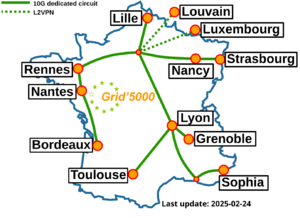
[[Image:g5k-backbone.png|thumbnail|260px|right|Grid'5000|link=https://www.grid5000.fr]]
[[Image:Logo_SC07-3.png|left|SuperComputing 2007]]
'''Grid'5000 is a large-scale and flexible testbed for experiment-driven research in all areas of computer science, with a focus on parallel and distributed computing, including Cloud, HPC, Big Data and AI.'''
===[http://sc07.supercomputing.org/ Grid'5000 at SC'07]===
 
Grid'5000 is present at SuperComputing 2007, Reno, Nevada (USA). We will be pleased to welcome you at INRIA's booth #2433 and present the platform, its tools, and ALADDIN: INRIA initiative to foster the platform development and research on Grids.
Key features:
* provides '''access to a large amount of resources''': 15000 cores, 800 compute-nodes grouped in homogeneous clusters, and featuring various technologies: PMEM, GPU, SSD, NVMe, 10G and 25G Ethernet, Infiniband, Omni-Path
* '''highly reconfigurable and controllable''': researchers can experiment with a fully customized software stack thanks to bare-metal deployment features, and can isolate their experiment at the networking layer
* '''advanced monitoring and measurement features for traces collection of networking and power consumption''', providing a deep understanding of experiments
* '''designed to support Open Science and reproducible research''', with full traceability of infrastructure and software changes on the testbed
* '''a vibrant community''' of 500+ users supported by a solid technical team


[[Image:Logo_Das3.jpg|left|80px]]
<br>
===[http://www.cs.vu.nl/das3/index.shtml Grid'5000 - DAS3 interconnection]===
Read more about our [[Team|teams]], our [[Publications|publications]], and the [[Grid5000:UsagePolicy|usage policy]] of the testbed. Then [[Grid5000:Get_an_account|get an account]], and learn how to use the testbed with our [[Getting_Started|Getting Started tutorial]] and the rest of our [[:Category:Portal:User|Users portal]].
The network interconnection between [http://www.cs.vu.nl/das3/index.shtml DAS3] (The Netherlands grid initiative) and Grid'5000 is now operational with grid-to-grid 10Gb/s interconnectivity. Preliminary tests began.


[[Image:Logo_Naregi.gif|left]]
<br>
===[http://www.naregi.org/index_e.html Grid'5000 - Naregi interconnection]===
Published documents and presentations:
The network interconnection between [http://www.naregi.org/index_e.html Naregi] (Japan grid initiative) and Grid'5000 is now operational and some preliminary tests began this summer.
* [[Media:Grid5000.pdf|Presentation of Grid'5000]] (April 2019)
* [https://www.grid5000.fr/mediawiki/images/Grid5000_science-advisory-board_report_2018.pdf Report from the Grid'5000 Science Advisory Board (2018)]


Older documents:
* [https://www.grid5000.fr/slides/2014-09-24-Cluster2014-KeynoteFD-v2.pdf Slides from Frederic Desprez's keynote at IEEE CLUSTER 2014]
* [https://www.grid5000.fr/ScientificCommittee/SAB%20report%20final%20short.pdf Report from the Grid'5000 Science Advisory Board (2014)]


[[Grid5000:News|read more news]]
<br>
Grid'5000 is supported by a scientific interest group (GIS) hosted by Inria and including CNRS, RENATER and several Universities as well as other organizations. Inria has been supporting Grid'5000 through ADT ALADDIN-G5K (2007-2013), ADT LAPLACE (2014-2016), and IPL [[Hemera|HEMERA]] (2010-2014).
|}
|}


<br>
<br>
==Grid'5000 at a glance==
{{#status:0|0|0|http://bugzilla.grid5000.fr/status/upcoming.json}}
[[Image:site_map.png|thumbnail|128px|right|Grid'5000 sites]]
<br>
* '''Grid'5000''' project aims at building a '''highly reconfigurable, controlable and monitorable experimental Grid platform''' gathering '''9 sites''' geographically distributed in France featuring a total of 5000 processors:
 
===Sites:===
== Random pick of publications ==
{|width="75%" cellspacing="3"  
{{#publications:}}
 
==Latest news==
<rss max=4 item-max-length="2000">https://www.grid5000.fr/rss/G5KNews.php</rss>
----
[[News|Read more news]]
 
=== Grid'5000 sites===
{|width="100%" cellspacing="3"  
|- valign="top"
|- valign="top"
|width="33%" bgcolor="#f5f5f5" style="border:1px solid #cccccc;padding:1em;padding-top:0.5em;"|
|width="33%" bgcolor="#f5f5f5" style="border:1px solid #cccccc;padding:1em;padding-top:0.5em;"|
* [[Bordeaux:Home|Bordeaux]]
* [[Grenoble:Home|Grenoble]]
* [[Lille:Home|Lille]]
* [[Luxembourg:Home|Luxembourg]]
* [[Louvain:Home|Louvain]]
|width="33%" bgcolor="#f5f5f5" style="border:1px solid #cccccc;padding:1em;padding-top:0.5em;"|
|width="33%" bgcolor="#f5f5f5" style="border:1px solid #cccccc;padding:1em;padding-top:0.5em;"|
* [[Lyon:Home|Lyon]]
* [[Nancy:Home|Nancy]]
* [[Orsay:Home|Orsay]]
* [[Nantes:Home|Nantes]]
* [[Rennes:Home|Rennes]]
|width="33%" bgcolor="#f5f5f5" style="border:1px solid #cccccc;padding:1em;padding-top:0.5em;"|
|width="33%" bgcolor="#f5f5f5" style="border:1px solid #cccccc;padding:1em;padding-top:0.5em;"|
* [[Rennes:Home|Rennes]]
* [[Sophia:Home|Sophia-Antipolis]]
* [[Strasbourg:Home|Strasbourg]]
* [[Toulouse:Home|Toulouse]]
|-
|-
|}
|}


* The main purpose of this platform is to serve as an experimental testbed for research in Grid Computing.
== Current funding ==
* This project is one initiative of the [http://www.recherche.gouv.fr/recherche/fns/grid.htm French ACI Grid] incentive (see below: Funding Institutions) which provides a large part of Grid'5000 funding on behalf of the French Ministry of Research & Education.


[[Image:Software layers.png|thumbnail|271px|left|Grid'5000 will allow Grid experiments France wide in all these software layers]]
* '''Grid'5000''' is a research effort developping a '''large scale nation wide infrastructure for Grid research'''.
 
* '''17 [[Grid5000:Laboratories|laboratories]]''' are involved, nation wide, in the objective of providing the community of Grid researchers a testbed allowing experiments in all the software layers between the network protocols up to the applications.


The current plans are to assemble a physical platform featuring 9 local platform (at least one cluster per site), each with 100 to a thousand PCs, connected by the [http://www.renater.fr RENATER] Education and Research Network.
 
All clusters will be connected to Renater with a 10Gb/s link (or at least 1 Gb/s, when 10Gb/s is not available yet).


This high collaborative research effort is funded by the French ministry of Education and Research, INRIA, CNRS, the Universities of all sites and some regional councils.


==Rationale==
'''The foundations of Grid'5000''' have emerged from a thorough analysis and numerous discussions about methodologies used for scientific research in the Grid domain. A report presents the [http://www-sop.inria.fr/aci/grid/public/Library/rapport-grid5000-V3.pdf rationale for Grid'5000].
 
In addition to theory, simulators and emulators, there is a strong need for '''large scale testbeds''' where real life experimental conditions hold. '''The size of Grid'5000''', in terms of number of sites and number of processors per site, was established according to the scale of the experiments and the number of researchers involved in the project.


==Funding Institutions==
{|width="100%" cellspacing="3"
|-
| width="50%" bgcolor="#f5f5f5" valign="top" align="center" style="border:1px solid #cccccc;padding:1em;padding-top:0.5em;"|
===Ministère de l'Education, de la Jeunesse et de la Recherche===
[[Image:Logo-ministere.png]]
| width="50%" bgcolor="#f5f5f5" valign="top" align="center" style="border:1px solid #cccccc;padding:1em;padding-top:0.5em;"|
===ACI Grid===
[[Image:LogoACIGRID.jpg|350px]]
|-
|-
| width="50%" bgcolor="#f5f5f5" valign="top" align="center" style="border:1px solid #cccccc;padding:1em;padding-top:0.5em;"|
| width="50%" bgcolor="#f5f5f5" valign="top" align="center" style="border:1px solid #cccccc;padding:1em;padding-top:0.5em;"|
===INRIA===
===INRIA===
[[Image:Logo-inria.png]]
[[Image:Logo_INRIA.gif|300px|link=https://www.inria.fr]]
| width="50%" bgcolor="#f5f5f5" valign="top" align="center" style="border:1px solid #cccccc;padding:1em;padding-top:0.5em;"|
| width="50%" bgcolor="#f5f5f5" valign="top" align="center" style="border:1px solid #cccccc;padding:1em;padding-top:0.5em;"|
===CNRS===
===CNRS===
[[Image:Logo-cnrs.png]]
[[Image:CNRS-filaire-Quadri.png|125px|link=https://www.cnrs.fr]]
|-
|-
| width="50%" bgcolor="#f5f5f5" valign="top" align="center" style="border:1px solid #cccccc;padding:1em;padding-top:0.5em;"|
| width="50%" bgcolor="#f5f5f5" valign="top" align="center" style="border:1px solid #cccccc;padding:1em;padding-top:0.5em;"|
===Universities===
===Universities===
University of Paris Sud, Orsay<br/>
IMT Atlantique<br/>
University Joseph Fourier, Grenoble<br/>
Université Grenoble Alpes, Grenoble INP<br/>
University of Nice-Sophia Antipolis, Sophia Antipolis<br/>
Université Rennes 1, Rennes<br/>
University of Rennes 1, Rennes<br/>
Institut National Polytechnique de Toulouse / INSA / FERIA / Université Paul Sabatier, Toulouse<br/>
University Bordeaux 1, Bordeaux<br/>
Université Bordeaux 1, Bordeaux<br/>
University Lille 1 / GENOPOLE, Lille<br/>
Université Lille 1, Lille<br/>
Ecole Normale Supérieure / MYRICOM, Lyon<br/>
École Normale Supérieure, Lyon<br/>
| width="50%" bgcolor="#f5f5f5" valign="top" align="center" style="border:1px solid #cccccc;padding:1em;padding-top:0.5em;"|
| width="50%" bgcolor="#f5f5f5" valign="top" align="center" style="border:1px solid #cccccc;padding:1em;padding-top:0.5em;"|
===Regional councils===
Aquitaine<br/>
Auvergne-Rhône-Alpes<br/>
Bretagne<br/>
Bretagne<br/>
Champagne-Ardenne<br/>
Provence Alpes Côte d'Azur<br/>
Aquitaine<br/>
Hauts de France<br/>
Ile de France<br/>
Lorraine<br/>
Lorraine<br/>
===General Councils===
Alpes Maritimes
|}
|}

Latest revision as of 15:03, 11 June 2026

Slices-ri-white-color.png

Grid'5000 is a precursor infrastructure of SLICES-FR, the French node of SLICES-RI, Scientific Large Scale Infrastructure for Computing/Communication Experimental Studies.
Content on this website is partly outdated. Technical information remains relevant.

Grid'5000

Grid'5000 is a large-scale and flexible testbed for experiment-driven research in all areas of computer science, with a focus on parallel and distributed computing, including Cloud, HPC, Big Data and AI.

Key features:

  • provides access to a large amount of resources: 15000 cores, 800 compute-nodes grouped in homogeneous clusters, and featuring various technologies: PMEM, GPU, SSD, NVMe, 10G and 25G Ethernet, Infiniband, Omni-Path
  • highly reconfigurable and controllable: researchers can experiment with a fully customized software stack thanks to bare-metal deployment features, and can isolate their experiment at the networking layer
  • advanced monitoring and measurement features for traces collection of networking and power consumption, providing a deep understanding of experiments
  • designed to support Open Science and reproducible research, with full traceability of infrastructure and software changes on the testbed
  • a vibrant community of 500+ users supported by a solid technical team


Read more about our teams, our publications, and the usage policy of the testbed. Then get an account, and learn how to use the testbed with our Getting Started tutorial and the rest of our Users portal.


Published documents and presentations:

Older documents:


Grid'5000 is supported by a scientific interest group (GIS) hosted by Inria and including CNRS, RENATER and several Universities as well as other organizations. Inria has been supporting Grid'5000 through ADT ALADDIN-G5K (2007-2013), ADT LAPLACE (2014-2016), and IPL HEMERA (2010-2014).


Current status (at 2026-06-26 11:07): 7 current events, 4 planned (details)


Random pick of publications

Five random publications that benefited from Grid'5000 (at least 2954 overall):

  • Maurice Brémond, Hugo Brunie, Laurent Debreu, Rupert W Ford, Florian Lemarié, et al.. Poseidon: A Source-to-Source Translator for Holistic HPC Optimizations of Ocean Models on Regular Grids. SC 2024 - International Conference for High Performance Computing, Networking, Storage, and Analysis, Nov 2024, Atlanta (Georgia), United States. , pp.1-1, 2024, 10.5281/zenodo.11190458. hal-04811677 view on HAL pdf
  • Maxime Agusti, Eddy Caron, Benjamin Fichel, Laurent Lefèvre, Olivier Nicol, et al.. PowerHeat: A non-intrusive approach for estimating the power consumption of bare metal water-cooled servers. 2024 IEEE International Conferences on Internet of Things (iThings) and IEEE Green Computing & Communications (GreenCom) and IEEE Cyber, Physical & Social Computing (CPSCom) and IEEE Smart Data (SmartData) and IEEE Congress on Cybermatics, Aug 2024, Copenhagen, Denmark. pp.1-7. hal-04662683 view on HAL pdf
  • Baptiste Jonglez, Matthieu Simonin, Jolan Philippe, Sidi Mohammed Kaddour. Multi-provider capabilities in EnOSlib: driving distributed system experiments on the edge-to-cloud continuum. DAIS 2025: 25th International Conference on Distributed Applications and Interoperable Systems, Jun 2025, Lille, France. pp.25-42, 10.1007/978-3-031-95728-4_2. hal-05052776 view on HAL pdf
  • Danilo Carastan-Santos, Georges da Costa, Millian Poquet, Patricia Stolf, Denis Trystram. Light-weight prediction for improving energy consumption in HPC platforms. Euro-Par 2024, Carretero, J., Shende, S., Garcia-Blas, J., Brandic, I., Olcoz, K., Schreiber, M., Aug 2024, Madrid, Spain. pp.152-165, 10.1007/978-3-031-69577-3_11. hal-04566184v2 view on HAL pdf
  • Barbara Gendron, Gaël Guibon. SEC: Context-Aware Metric Learning for Efficient Emotion Recognition in Conversation. Proceedings of the 14th Workshop on Computational Approaches to Subjectivity, Sentiment, & Social Media Analysis (WASSA at ACL 2024), Aug 2024, Bangkok, Thailand. hal-04702997 view on HAL pdf


Latest news

Rss.svgChanges to VS Code and AI Extensions Usage on Frontend

Recently, we have observed a critical increase in resource consumption (CPU and memory) on these nodes. This is primarily caused by VS Code Server (or similar) instances and associated AI-assisted coding extensions (such as Copilot, Tabnine, or local LLM agents) running directly on the frontend.

As a reminder, frontends are strictly dedicated to lightweight tasks: code editing, file management, and job submission. Running heavy background processes or AI agents on these shared machines degrades performance for the entire community and risks crashing the machines. Frontend are not sized for heavy code/system compilation/build either. Heavy tasks must be run on reserved nodes.

What is changing:

- ban on frontend: running VS Code Server (or similar), AI extensions, or any background development agents directly on the frontend will shortly be prohibited. - automated cleanup: we will actively monitor these nodes. Any unauthorized, resource-intensive processes or persistent VS Code servers found running on the login nodes will be terminated without prior warning.

How to continue using VS Code and AI tools?:

We fully understand that these tools could be essential for your work. Therefore, this usage is completely permitted and supported on the compute nodes.

To use VS Code and your AI agents properly, you must schedule an interactive session via the batch scheduler (OAR). You can do this by:

- Requesting an interactive allocation using oarsub -I.

- Tunneling your VS Code Remote-SSH connection directly to the allocated compute node instead of the frontend

This ensures you have dedicated resources for your AI tools without impacting other users.

-- Grid'5000 Team 16:00, 15 Jun 2026 (CEST)

Rss.svgEnd of support for Rocky8/9 and ubuntu2004

Support for the Rocky8/9 and Ubuntu2004 kadeploy environments is stopped due to the end of upstream support and compatibility issues with recent hardware.

The last version of the Rocky8 environments (version 2024071119), Rocky9 environments (version 2024071119), Ubuntu2004 environments (version 2025031116) will remain available on /grid5000.

Older versions can still be accessed in the archive directory (see /grid5000/README.unmaintained-envs for more information).

-- Grid'5000 Team 09:40, 10 May 2026 (CEST)

Rss.svgCluster Chicoree is now in default queue at Lille

We are pleased to announce that the Chicoree [1] cluster is now available in the default queue.

Chicoree is a cluster composed of 1 Proliant DL380a Gen12 node, featuring:

  • 2x Intel Xeon 6530P (Granite Rapids), 32 cores/CPU
  • 4x Nvidia H200 141GB GPU with NVLink
  • 1 TiB RAM
  • 4x 3.2 TB NVMe
  • 2x 25Gbps network interface
  • This cluster was funded by the CPER CornelIA.

    This cluster is tagged as "exotic", so the `-t exotic` option must be provided to oarsub to select chicoree.

    [1] https://www.grid5000.fr/w/Lille:Hardware#chicoree

    Best regards, Grid'5000 Technical Team

    -- Grid'5000 Team 09:30, 04 June 2026 (CEST)

    Rss.svgCluster Sasquatch is now in default queue at Grenoble

    We are pleased to announce that the Sasquatch [1] cluster is now available in the default queue.

    Sasquatch is a cluster composed of 2 HPE RL300 nodes, each featuring:

  • 1x ARM64 CPU Neoverse-N1 (Ares) 80 cores/CPU (Ampere altra) [2]
  • 1 TiB RAM
  • 1x 1.6 TB NVMe
  • 2x 25Gbps network interface (first NIC wired at 25Gbps and second NIC at 10Gbps)
  • This cluster was funded by the PEPR IA.

    [1] https://www.grid5000.fr/w/Grenoble:Hardware#sasquatch

    [2] https://amperecomputing.com/briefs/ampere-altra-family-product-brief

    Best regards, Grid'5000 Technical Team

    -- Grid'5000 Team 10:15, 11 February 2026 (CEST)


    Read more news

    Grid'5000 sites

    Current funding

    INRIA

    Logo INRIA.gif

    CNRS

    CNRS-filaire-Quadri.png

    Universities

    IMT Atlantique
    Université Grenoble Alpes, Grenoble INP
    Université Rennes 1, Rennes
    Institut National Polytechnique de Toulouse / INSA / FERIA / Université Paul Sabatier, Toulouse
    Université Bordeaux 1, Bordeaux
    Université Lille 1, Lille
    École Normale Supérieure, Lyon

    Regional councils

    Aquitaine
    Auvergne-Rhône-Alpes
    Bretagne
    Champagne-Ardenne
    Provence Alpes Côte d'Azur
    Hauts de France
    Lorraine