Grid5000:Home: Difference between revisions
No edit summary |
mNo edit summary |
||
| (2 intermediate revisions by the same user not shown) | |||
| Line 12: | Line 12: | ||
|- valign="top" | |- valign="top" | ||
|bgcolor="#f5fff5" style="border:1px solid #cccccc;padding:1em;padding-top:0.5em;width:70%"| | |bgcolor="#f5fff5" style="border:1px solid #cccccc;padding:1em;padding-top:0.5em;width:70%"| | ||
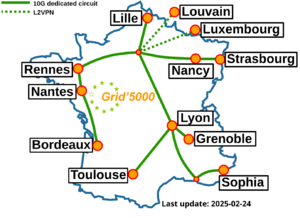
[[Image:g5k-backbone.png|thumbnail| | [[Image:g5k-backbone.png|thumbnail|300px|left||link=https://www.grid5000.fr]] | ||
'''Grid'5000 is a large-scale and flexible testbed for experiment-driven research in all areas of computer science, with a focus on parallel and distributed computing, including Cloud, HPC, Big Data and AI.''' | '''Grid'5000 is a large-scale and flexible testbed for experiment-driven research in all areas of computer science, with a focus on parallel and distributed computing, including Cloud, HPC, Big Data and AI.''' | ||
| Line 27: | Line 27: | ||
<br> | <br> | ||
Published documents and presentations: | Published documents and presentations: | ||
* [https://www.inria.fr/fr/grid5000-20-ans-hpc-reseau-informatique 20th anniversary commemoration (2023)] | * [https://www.inria.fr/fr/grid5000-20-ans-hpc-reseau-informatique 20th anniversary commemoration (2023)] → [https://www.youtube.com/watch?v=UD5-Y0vcmVI presentations video replay] (French only) | ||
* [[Media:Grid5000.pdf|Presentation of Grid'5000]] (April 2019) | * [[Media:Grid5000.pdf|Presentation of Grid'5000]] (April 2019) | ||
* [https://www.grid5000.fr/mediawiki/images/Grid5000_science-advisory-board_report_2018.pdf Report from the Grid'5000 Science Advisory Board (2018)] | * [https://www.grid5000.fr/mediawiki/images/Grid5000_science-advisory-board_report_2018.pdf Report from the Grid'5000 Science Advisory Board (2018)] | ||
| Line 38: | Line 38: | ||
Grid'5000 is supported by a scientific interest group (GIS) hosted by Inria and including CNRS, RENATER and several Universities as well as other organizations. Inria has been supporting Grid'5000 through ADT ALADDIN-G5K (2007-2013), ADT LAPLACE (2014-2016), and IPL [[Hemera|HEMERA]] (2010-2014). | Grid'5000 is supported by a scientific interest group (GIS) hosted by Inria and including CNRS, RENATER and several Universities as well as other organizations. Inria has been supporting Grid'5000 through ADT ALADDIN-G5K (2007-2013), ADT LAPLACE (2014-2016), and IPL [[Hemera|HEMERA]] (2010-2014). | ||
|| | || | ||
'''Most recent news''' | |||
<rss max=4 item-max-length="150">https://www.grid5000.fr/rss/G5KNews.php</rss> | <rss max=4 item-max-length="150">https://www.grid5000.fr/rss/G5KNews.php</rss> | ||
<center> | <center> | ||
Latest revision as of 12:46, 27 August 2026
 Grid'5000 is a precursor infrastructure of SLICES-FR, the French node of SLICES-RI, Scientific Large Scale Infrastructure for Computing/Communication Experimental Studies.
|
|
Grid'5000 is a large-scale and flexible testbed for experiment-driven research in all areas of computer science, with a focus on parallel and distributed computing, including Cloud, HPC, Big Data and AI. Key features:
Older documents:
|
Most recent news
Dear users, We are pleased to announce that Debian 13 (Trixie) std environment is now the default environment on most nodes. See `kaenv3...
Dear users, The default standard environment has changed to Debian 13 for some selected clusters over the past few weeks. Here the... Hello everyone, Let's start with a quick TLDR, details on the rationale and implementation are available below: new modules will be avail...
Recently, we have observed a critical increase in resource consumption (CPU and memory) on these nodes. This is primarily caused by VS Code Serv... |

Random pick of publications
Five random publications that benefited from Grid'5000 (at least 3009 overall):
- Louis Roussel, Rashid Barket. How Many Decay Factors Do You Need? Tree Positional Encoding for Symbolic Mathematics. 2026. hal-05760452 view on HAL pdf
- François Lemaire, Louis Roussel. A Parametric Differential System Admitting an Integral Input-Output Equation with a Fraction. Computer Algebra in Scientific Computing (CASC) 28th International Workshop, Aug 2026, Bath (UK), United Kingdom. hal-05645783 view on HAL pdf
- Alexandre Sabbadin, Tom Guérout. Towards a Classification of Edge Service Orchestration Strategies Integrating Renewable Energy. 22nd International Conference on Service-Oriented Computing (ICSOC 2024), Dec 2024, Tunis (Tunisie), Tunisia. hal-05010531 view on HAL pdf
- Vladimir Ostapenco, Laurent Lefèvre, Anne-Cécile Orgerie, Benjamin Fichel. Exploring RAPL as a Power Capping Leverage for Power-Constrained Infrastructures. ICA3PP 2024 - 24th International Conference on Algorithms and Architectures for Parallel Processing, Oct 2024, Macau SAR, China. pp.1-10. hal-04742418 view on HAL pdf
- Bruno Lévy, Nicolas Ray, Quentin Merigot, Hugo Leclerc. Large-scale semi-discrete optimal transport with distributed Voronoi diagrams. Journal of Computational Physics, 2025, pp.114374. 10.1016/j.jcp.2025.114374. hal-05253830 view on HAL pdf
Grid'5000 sites
Current funding
INRIA
|
CNRS
|
UniversitiesIMT Atlantique |
Regional councilsAquitaine |