Grid5000:Home
 Grid'5000 is a precursor infrastructure of SLICES-FR, the French node of SLICES-RI, Scientific Large Scale Infrastructure for Computing/Communication Experimental Studies.
|
|
Grid'5000 is a large-scale and flexible testbed for experiment-driven research in all areas of computer science, with a focus on parallel and distributed computing, including Cloud, HPC, Big Data and AI. Key features:
Older documents:
|
Random pick of publications
Five random publications that benefited from Grid'5000 (at least 3000 overall):
- Théophile Bastian. Towards automatic characterization of microarchitectural behaviour form performance modeling of computing kernels : an analysis of the Cortex A72 and Intel microarchitectures. Hardware Architecture cs.AR. Université Grenoble Alpes 2020-.., 2024. English. NNT : 2024GRALM072. tel-05116111 view on HAL pdf
- Gautier Evennou, Vivien Chappelier, Ewa Kijak, Teddy Furon. SWIFT: Semantic Watermarking for Image Forgery Thwarting. WIFS 2024 - 16th IEEE International Workshop on Information Forensics and Security, IEEE, Dec 2024, Roma, Italy. pp.1-6. hal-04728070 view on HAL pdf
- Ndeye-Emilie Mbengue, Pierre Monnin, Miguel Couceiro, Fabien Gandon. Which Are the Low-Resource Languages of the Semantic Web?. ESWC 2026 - 23rd European Semantic Web Conference, May 2026, Dubrovnik, Croatia. hal-05607932 view on HAL pdf
- Danilo Carastan-Santos, Georges da Costa, Millian Poquet, Patricia Stolf, Denis Trystram. Light-weight prediction for improving energy consumption in HPC platforms. Euro-Par 2024, Carretero, J., Shende, S., Garcia-Blas, J., Brandic, I., Olcoz, K., Schreiber, M., Aug 2024, Madrid, Spain. pp.152-165, 10.1007/978-3-031-69577-3_11. hal-04566184v2 view on HAL pdf
- Cédric Boscher, Nawel Benarba, Fatima Elhattab, Sara Bouchenak. Personalized Privacy-Preserving Federated Learning. Proceedings of the 25th International Middleware Conference, Dec 2024, Hong Kong, China. pp.454--466, 10.1145/3652892.3700785. hal-04770214 view on HAL pdf
Latest news
 Some clusters under Debian 13 "Trixie" environment by default and migration maintenance
Dear users,
The default standard environment has changed to Debian 13 for some
selected clusters over the past few weeks.
Here they are:
This is a key step towards the widespread deployment of Debian13. Most
clusters will be switched to a Debian 13 default environment Wednesday 26 August 2026.
If you need to, all the variants images (min, nfs, big) are available
for deployment, see `kaenv3 -l debian%13%` on frontends to list them.
Remember that there is a significant change concerning the modules. See
the preview announce : https://www.grid5000.fr/w/News#Upcoming_changes_to_modules
Best regards,
For Abaca and Grid'5000/SLICES-FR,
Nicolas Perrin
-- Grid'5000 Team 16:00, 02 Jul 2026 (CEST)
Hello everyone,
Let's start with a quick TLDR, details on the rationale and implementation are available below: new modules will be available with the new standard environment, and are already live for testing (but not activated by default).
If you want to test them you need to run the following commands:
unset MODULEPATH
module use /grid5000/guix-modules/x86_64/latest
/grid5000/spack/module-others
Now for more details: for the past months we have been working on updating the standard environment and the way we provide modules.
The current way uses Spack under the hood, and is tightly bound to the underlying operating system.
It's been proven to be quite a burden for the team, and therefore we are changing the way we manage modules to:
- use a solution oblivious to the Linux flavor; - have means to update software versions automatically, and a clear release cycle; - actually have something reproducible; - be able to automatically test our most sensitive modules when they change (on both OAR and SLURM clusters).
Under the hood we switched to Guix to manage them²; it will be totally transparent for you.
The upcoming modules are located in `/grid5000/guix-modules/x86_64`, and you can try them today!
In order to use them you need to perform the following commands¹:
unset MODULEPATH
module use /grid5000/guix-modules/x86_64/latest
The list of modules for the `latest` release is available here:
https://api.grid5000.fr/explorer/software.
We know it's missing a few software compared to the current modules, we've tracked them here.
These should b...
Changes to VS Code and AI Extensions Usage on Frontend
Recently, we have observed a critical increase in resource consumption (CPU and memory) on these nodes. This is primarily caused by VS Code Server (or similar) instances and associated AI-assisted coding extensions (such as Copilot, Tabnine, or local LLM agents) running directly on the frontend.
As a reminder, frontends are strictly dedicated to lightweight tasks: code editing, file management, and job submission. Running heavy background processes or AI agents on these shared machines degrades performance for the entire community and risks crashing the machines. Frontend are not sized for heavy code/system compilation/build either. Heavy tasks must be run on reserved nodes.
What is changing:
- ban on frontend: running VS Code Server (or similar), AI extensions, or any background development agents directly on the frontend will shortly be prohibited. - automated cleanup: we will actively monitor these nodes. Any unauthorized, resource-intensive processes or persistent VS Code servers found running on the login nodes will be terminated without prior warning.
How to continue using VS Code and AI tools?:
We fully understand that these tools could be essential for your work. Therefore, this usage is completely permitted and supported on the compute nodes.
To use VS Code and your AI agents properly, you must schedule an interactive session via the batch scheduler (OAR). You can do this by:
- Requesting an interactive allocation using oarsub -I.
- Tunneling your VS Code Remote-SSH connection directly to the allocated compute node instead of the frontend
This ensures you have dedicated resources for your AI tools without impacting other users.
-- Grid'5000 Team 16:00, 15 Jun 2026 (CEST)
End of support for Rocky8/9 and ubuntu2004
Support for the Rocky8/9 and Ubuntu2004 kadeploy environments is stopped due to the end of upstream support and compatibility issues with recent hardware.
The last version of the Rocky8 environments (version 2024071119), Rocky9 environments (version 2024071119), Ubuntu2004 environments (version 2025031116) will remain available on /grid5000.
Older versions can still be accessed in the archive directory (see /grid5000/README.unmaintained-envs for more information).
-- Grid'5000 Team 09:40, 10 May 2026 (CEST)
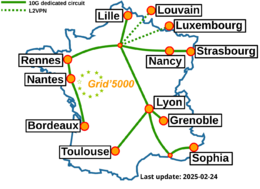
Grid'5000 sites
Current funding
INRIA
|
CNRS
|
UniversitiesIMT Atlantique |
Regional councilsAquitaine |